5.6 GPM vs. 7.7 GPM

Jim Andrews

New member
We are going to set up a new rig with a 7.7 GPM pump. How much difference should we notice in speed of surface cleaning, rinsing, etc. vs. a 5.6 GPM pump? Will it be very noticeable or just a little better. We have no idea as we have never squeezed the gun on a 7.7 but it sounds like it could be fun.
 
Well, I would think the difference would be like comparing your 5.6 gpm to a 3.5 gpm. I know the difference between my 4 gpm and my 5.5 gpm is quite a bit. I think the extra 2.1 gpm would be very noticeable.
 
remember

some pump co. like to add a little to the GPM numbers.
Have you ever tested your old unit to see what it really put's out?
What HP is your old rig and what is the engine HP of the new rig?
Most spigots can run the smaller pump but not your new one. What size is your supply tank and what do you wash?
Are either of them a hot water rig?
That 7 should be great to run a big surface cleaner.
 
We will have a 525 gallon supply tank and we wash anything from single wide trailers to banks to million dollar homes. The engine we are currently using is a 15 HP Kubota diesel and I love it. The new rig is a 25 HP water cooled Kohler and both are hot water. I understand about the fudging of the gpm numbers. I guess I need to test our current set up to see what it really is putting out, never done that before. And that is what I'm thinking too Ron, being able to run a bigger surface cleaner. Could cut some time on the concrete, cleaning and rinsing. I was hoping to hear from someone that is currently using a similar set up to see how it does. Thanks for the reply.
 
i am curious to know opinions from anyone who has this setup as well,i would also like to know what advantages a 12 gpm pump would be over an 8gpm,i wonder if you could have too much flow for most practical applications?
 
The Advantages:

-Higher flow rate reduces the time that it takes to clean an object.

-The fellow from Epps in one of his posts explained flow very well. Consider a baseball thrown and being caught at whatever speed. Increase the size of the baseball to say a bowling ball traveling at the same speed! That is kind of what the difference is in increased flow.

The Disadvantages:

-Will have more wastewater to deal with. Must have a larger supply tank. Need more fuel to create hot water. You can damage objects easier/faster!

-The person running the wand will have more aches and pains at the end of the day. More flow relates to increased recoil. Operator has a harder time holding on to the wand!

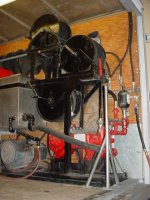
Our primary unit operates at the full range of pressures up to 3000 psi and volumes up to around 9.5 gpm. We have a by-pass relief valve that we use. We dial up the pressure that we want from around 1000 psi to 3000 psi (pressure gage on discharge of pump). We select a tip based on how much water we want to use on that line. Many times we run 2 lines. We also use ball valves rather than trigger guns. This allows us to reduce pressure and flow again on that line. We use this for running our hose end sprayers (chemical application).

I will try to post a picture of this pump, showing our hose reels, surge tank and drive motor.

Dave Olson
 

Attachments

  • wheatley 9 02.jpg
    wheatley 9 02.jpg
    73.6 KB · Views: 135
Water volume

We use two diesel set up's (cold water) one at 10 gpm at 1500 psi and the other is 12 gpm at 2000 psi. Compared to my little 18 honda 5.6 gpm it is night and day. Water volume cleans!! It depends on what you are cleaning and how fast you want it cleaned. We run off two hose bibs and fill a 30 gallon tank with pressure to keep up the demand for the pump. Very few water problems unless it is a well, which we avoid most of the time anyway. My guys can wand sidewalks with the 10 gpm faster than using the honda 18 with the big guy! Tips are key depending on what you are cleaning. The zero tip using a 0020 is great for touch ups on roofs, knocking down spider webs with no brushing, wasp nests, etc.

I would like to add a boiler to the system but I am not sure if it is practical with the high water volume, (will it keep the water hot enough or heat fast enough?) Any thoughts would be helpful. JIM
JTwist6904@aol.com
 
Last edited:
Thanks Dave for your reply,i recently switched to a 5.6 from a 4.8 and definately noticed a difference in how fast i could clean an object and how much more energy was required to maneuver a 12 foot wand,not to mention the fuel this thing uses(25hp Kohler).
i had a job last week on a military compound cleaning a warehouse,that required two men on site at all times,i added a second line to my rig and it wasnt worth the effort so i sit in the truck mostly watching my guy work for two weeks.
for a two man rig i need at least 8gpm,but i always go overboard and would spend the extra money for a 12gpm pump,i dont know if i am ready to pay the price of sore muscles when using one gun though.
 
You can get a burner/boiler as big as you want! During our most recent upgrade/rebuild we replaced our 750,000 Btu stand alone boiler with a 980,000 Btu unit.

Does one heck of a job but they don't give them away! I will post a picture. Few months back we needed to soften up some product in a 5000 gallon tank. Cranked it up and we were makin steam!

Dave Olson
 

Attachments

  • red 24 volt switches and whitco.jpg
    red 24 volt switches and whitco.jpg
    55.7 KB · Views: 105
My crew was doing a kitchen last week. They had the truck sitting at the customers dock. Couldn't resist taking a picture. Just looked kinda neat all lit up and everthing around it was black (9 o clock at night).

This picture will also give those who have not seen it a prospective on how it looks compared to the other pictures that I have posted in this thread.

Dave Olson
 

Attachments

  • at dock of illini union 1 03 sm.jpg
    at dock of illini union 1 03 sm.jpg
    57.8 KB · Views: 113
Dave Olson

Where did you get that boiler? We have a really old one like that and we are looking for another, but have no idea where to begin.

Thank you for any help.
(sorry about straying off topic)


Jennie Miller
 
Thank you

both for the information. They are sending me a catalog.

Jennie
 
With thanks to Mr. Olson for his kind words allow me to add some hopefully useful information...

(Flow x Pressure)/ 1460= Electric Brake HP (this is a legitimate formula based on experience, not an engineering based theoretical value from charts showing relative component efficiency)

Brake HP x 1.5 = gasoline engine HP (again based on experience in life)

Water weighs 8.4#/US gallon or 1kg/litre (fact)

Impact force is (GPM x square root of PSI)/18.92 (this is theoretical but close enough to use)

Therefore at 7.7 GPM the operator will be dealing with 64.7# per minute coming from the nozzle.

7.7 GPM @ 3000 PSI would require a 15.8 HP electric motor or a 23.7 HP gasoline engine, minimum.

A 525 gallon tank will have a useful 473 gallons (90% utilization) or 61 1/2 minutes of run time. There is also the same amount of discharge that needs to be dealt with. Most municipal water supply is less than 6 GPM, few rural pumps offer much more.

Impact force would be 22.3# at 7.7 GPM, 5.6 GPM would give 16.2#. So there would be more cleaning available and would take ~27% less time to do the same job, with one gun or two.

A rule of thumb is that you will need 100,000 Btu to raise 1 gallon of water 140 degrees Farenheit. Therefore conventional wisdom says that you will need an 800,000 Btu burner. For LP this would burn about ~37# per hour; oil would be ~4.5 GPH.

Hope this helps? Cheers.

 
Back
Top