Is Anyone Doing New Construction Work?

Glenn & Steven Charge A few hundred, Paul you could get a thousand.. maybe you should take him up on this. two day training 1000.00 three days 1250.00 ... you could also put him to work for the 5 day training package for 2500.00..

Good luck Guys!!!
 
Paul, I completely respect your answer,maybe another time. I guess I will keep the questions here. My first question is the price per 1000. What does that mean, I am guessing per 1000 brick, if so, I am sure you don't really count out 1000 bricks. How do you come up with the figure? Mortar tags, I think this refers to mortar dripped on the brick, am I correct? Do you contract with the builders or just do the work as they call? I am sure I will have more questions, thanks in advance.
 
Mike,

Per 1000 bricks is correct. Most builders talk "per 1000" when talking cost and size, etc.

Like with cattle, we count the number of legs and divide by 4 to get a head count.

Seriously:
Large part of the time we work from drawings and specs. when we estimate. The drawings/specs will tell you the type of brick and size and sometimes general count. When done as part of the masonry estimate, we calculate the number of bricks based on the house or building dimensions. So yes, we calculate square footage, then convert to bricks and add a percentage for breakage. One of the watch-outs is that the brick specs. may change from the time you quote to the time of the build. We have a clause in the contract to cover that and work it with change management.

When bidding by count, there are several sizes of bricks so that's a major watchout. For example: In the Modular category you have Modular, Engineer Modular, Closure Modular, Roman, Norman, Engineer Norman and Utility (to name a few). Then you have the non-modular brick sizes. They each vary in size. The standard mortar joint is 3/8" For modular brick (2-1/4 x 7-5/8 specified) with 3/8" joint you would figure 6.87 bricks per square foot. (Some use 6.75 while others use 7 per square foot).

There are also hundreds (maybe thousands) of brick styles and color variations. Sand-struck, wire-cut, ruggs-face, smooth face, stippled face, sand-mold face, sand-struck face, matt face, toned, textured, water-struck, rustic-sand finish, antique finish to list a few.

OK to answer your question of how we bid.
- We bid from drawings.
- We at times measure then calculate square feet then convert (or not) to "per 1000".
- We can follow the mason and find out how many bricks he used. (This can make a few more bucks if you trust the mason because they get paid for total bricks (including broken bricks that are not layed). You also have to weed out the dishonest ones that break bricks on purpose to get the brick count up.
- Trust the builder for the brick count. (Everyone is honest, it only takes one time to remove that trust and change the relationship - so from time to time we measure.) You build his number into the contract and if it ends up different, then you still get paid because you bid by the 1000 or by the square foot and not by the job.
So your contract would say - total job cost is $720 based on assumption of 16K "modular" bricks at $45 per 1000.

There are other variations on the theme, but you need to keep it fairly simple when starting out. Learning will come rather quickly and hopefully without much expense. Always CYA (cover your donkey) in the estimate/contract.

Regards,
 
To answer your question:
"Do you contract with the builders or just do the work as they call?"

We have established rates (contract) with a couple of builders. We have agreed on what they are willing to pay and what we are willing to work for. This is for production (sub-division) work only. We will still submit an estimate on each building and obtain a signed contract, but we know we are not bidding against anyone else since the pricing structure is locked in. This guarantees us a certain amount of work for a period of time and helps to maintain employees. We have 6 month and 1 year contracts. Gives both sides a chance to renegotiate based on prevailing wages, supply and demand, overall market demand and competition, etc., etc..

We also contact builders to be added to the list of bidders.
Lot of times we get approached on a job site because they like the work we do (we always keep a sign at the work site). We drive around and talk to supers, builders anyone that will listen to us. We get leads from one builder that may have a cousin or a friend that builds also. We hand out cards, pens, brochures, 6-packs, baseball tickets, anything that can get us to a personal level. The more visability you have, the more chances you will have on bidding a job. The remainder is in the quality, cost and schedule.

To re-emphasize: Always, I mean "ALWAYS" have a document so both parties know what was agreed to. It is preferrable to have a signed contract. You may choose to make an exception from time to time, but make sure you understand what can happen.


Regards,
 
OK, I'll shut up if you make me.


Tags can vary in size from frog doo-doo size on up.
(Watch the large ones when you're scraping. Make sure you duck so it doesn't hit you in the head, if you're not wearing a hard hat.)

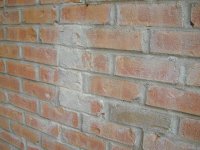
Below is a photo that shows mortar tags on top of mortar joints.
(Right side between 2nd and 4th row of bricks).


Regards,
 

Attachments

  • gpc-1278-44.jpg
    gpc-1278-44.jpg
    71.8 KB · Views: 183
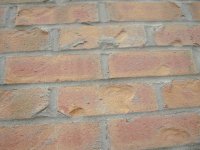
Mortar tags 2nd row from top.


Regards,
 

Attachments

  • gpc-1278-47.jpg
    gpc-1278-47.jpg
    70.7 KB · Views: 177
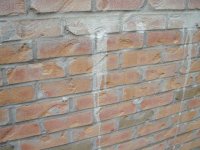
Mortar/Lime runs along with a couple of mortar tags to the left of the lime run.


Regards,
 

Attachments

  • gpc-1278-49.jpg
    gpc-1278-49.jpg
    70.4 KB · Views: 168
Last one and I'll shut up (maybe).


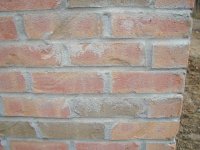
Mortar smears:


Regards,
 

Attachments

  • gpc-1278-46.jpg
    gpc-1278-46.jpg
    72.1 KB · Views: 164
Ron,

My consulting rates were upwards of $100 per hour plus expenses (unfortunately most of the time they only wanted me for 5-10 minutes).

There's a joke or three along that line:
This executive was hiring a secretary but the work also included sexual favors. The secretary didn't mind after he told her that he would pay her $100 per hour. First request on the job was of a sexual nature, after which he fired her. He only paid her for half an hours worth of work.

Let's see if I can hide one here while I have your attention:
She offered her honor, he honored her offer, so all night long it was honor, offer, honor, offer.

Here's another:
This fellow took this lass on a date. It was a long, long drive in the country which culminated in a picnic. They connected and ended with a roll in the grass. Afterwards she demanded $100 for the roll in the grass, since she claimed to be a hooker. He obliged her after some time and discussions including non-disclosure prior to the roll. When she asked him to take her home he told her it would cost her $200 for his taxi service since he was by occupation a cab driver and as of now was "On Duty".

Well I guess you had to be there.

Sorry about the distraction, but any day without laughter is like a day without sunshine.

Regards,
 
Ron,

Our present rate is $62.50/hr. if we do the work ourselves, $95/hr. if you watch and $150/hr. if you help.


Regards,
 
Paul, could you email me at bill3752@aol. Wondering if we share a common production residential builder. If so would like to discuss off line. Bill (from Louisville)
 
Thanks Paul, I would never ask you to "shut-up" I learned from every word you said. I think I got it now, just need to learn how to do the work. I take it even with the right chems. there is a lot of scrubbing by hand. Ok, now I need to find a sample contract, learn sizes of brick, then contact builders in my area. Thanks Paul, I am sure I will have more questions down the line for you.
 
Bill,

Hypothetically, you could say that a single, low maintenance masonry contract (supplying labor services) that had an earning potential of $1M+, with sales commission residuals of 3-1/2 % per year would be of significant importance to a business and its owners and employees. Adding P/W into this contract could increase the total value by another $35-40K and adding construction clean-up could again bump that value by another $40-50K.

Putting hypothetical aside, a significant portion of my contracts are directly or indirectly connected to the Masonry business, where I have interests. As any discussions on specifics (builder, or contract) could impact the owner(s) and employees, I am not able to name those contracts by name (on or off line). I hope you can appreciate my position.

However, I would be more than willing to talk general strategies if this is of any interest to you.

Regards,
 
Mike C.,

Scrubbing and scraping are still required unless you have non-glazed (un-coated) bricks, the masonry job was very clean and your very lucky that day.

As you will learn, every job is somewhat different - be it the type of bricks, the mortar joints, how long joints have cured, extremely sunny and hot days, etc., etc.

If you are interested in adding new construction cleaning to your bag, I would suggest (if you haven't already):
- Search the internet for cleaning info (lots of good data)
search under - brick cleaning - masonry cleaning - new construction cleaning.
- www.prosoco.com, www.diedrichtechnologies.com and Delco web sites offer a significant amount of info on masonry cleaning.
- Find some masonry supply shops near you and talk to some of the folks there on materials, procedures, etc.. You can make some contacts there (masons, builders, etc.) and can also leave your business card on their counters.
- And of course there are a few people on the BB's that will always help also.

Also make sure you check out the safety aspect, as you'll be working with acids (gloves, faceshield, etc.).

You'll also need to make sure you have:
- 28 or 32 foot extension ladder with leveling feet
- 10 or 12 foot ladder
- Pump up or prefferably shur-flo system (20 gallon tank)
- Tampico brushes
- Plastic to cover doors, doorways or fixtures in some cases.
- Scrapers
- An 18 foot extension wand can be very useful

Last, but not least expect to get dirty and muddy (both you and your equipment) since there will not be the soft grass or level, hard concrete under your feet. Most of the terrain will be very rough and uneven and elevation changes can get you some major ladder time.

Regards,

 
Here's a shot of our latest construction clean up job. We did both the vertical and the horizontal surfaces here for mortar removal. The masons has the stuff everywhere. We did the sidewalk surrounding the entire building as well as the building. We used a surface cleaner for this one too, it's just not in this photo.

Enjoy! :)

Beth:cool:
 

Attachments

  • brickjaspers.gif
    brickjaspers.gif
    63.1 KB · Views: 177
Beth,

- They got the awnings up very quickly ...or did you get the job in the late phase?

- Do you like the Prosoco products and have you compared it to the Diedrich products?


Regards,
Paul B.
 
They put the awnings up too soon, and had us in to clean the mortar much too late. The project was 2 MONTHS behind schedule. We had both interior and exterior work to do. The dates of service changed several times on us. By the time we finished inside they were already training the servers and doing practice runs. Not bad free meal wise, but hard to coordinate with everything else going on, since you had not just construction workers to keep in mind but also the training schedule of the staff.

We finished it this past week. Dave, our field supervisor oversaw the completion while we were in Pittsburgh.

We used Prosoco on this, that was given (as in a gift) to us by the Project Manager. He had several gallons laying around he wanted to get rid of. :)

Beth

p.s. Have not tried others yet....may in the future, but Prosoco is available to us locally.
 
We use all of the items listed by Paul, plus carry a whisk broom for cleaning sand off of ledges. A brick makes a good scraping tool - masonry houses and HD also carry a hand tool made for that purpose.

Paul - re: my earlier comment - I clean roughly 500 "front bricked" homes for a production builder that happens to be headquartered in Columbus, and feel we are getting 'underpaid'. Thought you may have their business up there. Understand and respect your wanting to not discuss.

Beth - maybe I can't see the dirty wall very well, but most of the jobs we are asked to clean are substantially dirtier than what I could see in your pic. Paul's pic looked slightly above average. Key is that when you have lots of large mortar tags, you need to manually scrape those off before any type of chemical treatment.
 
Hi Bill,
The remaining mortar is to the right of the photo. Most of it was gone, and the area is clean. The sidewalk is all done, the wall is the area that still has some trouble. I didn't get to the site in time to get better before shots. I was here in the office and just could not pull away. :(

There were "blobs" that we needed to get off as well. Just don't have a shot of them.

Beth
 
admin

when i tried to rate this thread i got this message

"vBulletin Message
ATTENTION ADMINISTRATOR: You MUST revert your showthread_threadrate template! "

you might know about this mike if so please ignor this post

cheers paul.
 
Back
Top